To show and hide the modal for editing purposes on Tablet:
- Select the filters2_filters-wrapper inside the parent div filters2_layout div.
- Hit the Hide button and it will show (yes this is counterintuitive).

Cabinet Battery Systems
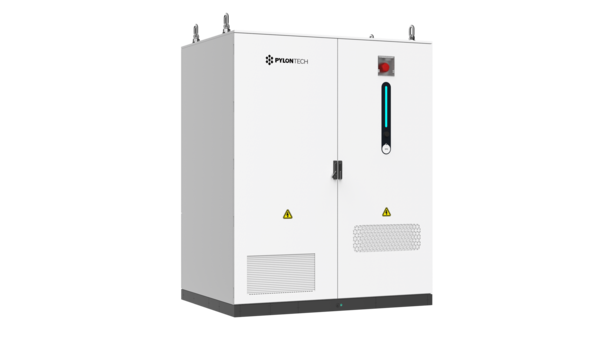
A battery cabinet is installed outdoors against the building facade or on the property. Frax supplies installers with cabinets offering 100 to 520 kWh of storage capacity for businesses with solar panels, peak demand, or a limited grid connection.


Filters


No results found.
There are no results with this search criteria. Try other search terms.
That's why installers trust Frax!
We take care of the groundwork: every system is fully prepared before it leaves our facility, so all you have to do on-site is install and connect it. If you run into any issues with system selection or inspection, our team will handle it. After delivery, you can use the included software to monitor the reliability of each system.
What is a cabinet battery system?
A cabinet battery system is a compact, modular energy storage unit housed in a weatherproof outdoor enclosure. Inside the cabinet are battery modules, an inverter that converts direct current (DC) to alternating current (AC), and a Battery Management System for monitoring the battery cells. Each cabinet in our product line is equipped with its own fire suppression system.
The batteries in all the cabinets in our product line are lithium iron phosphate, a type of lithium-ion battery with a higher thermal runaway temperature and a long service life. The IEC 62933-5-2 standard ensures the safety of these energy storage systems; our systems also comply with PGS 37-1, the stricter guideline for the storage of lithium-containing batteries.
How does a battery cabinet work?
The battery system charges the batteries when electricity is cheap or when the solar panels generate more power than the business consumes. Smart energy management technology automatically determines the most advantageous time for charging and discharging; the stored solar energy is released during peak hours for later use when electricity prices are at their highest.
Power and storage capacity together determine the C-factor. A 500-kW battery that stores 1,000 kWh has a C-factor of 0.5 and discharges at full power in two hours. You can tell how powerful a unit is by looking at the kW, not the kWh.
Our battery cabinets: from 100 to 520 kWh
1. Hybrid cabinets
The A100-HY and A300-HY combine batteries and an inverter in a single enclosure and connect directly to the solar panel array; the battery system stores the generated energy without requiring any additional components.
2. Omni Systems
The A200-OMNI and L260-OMNI (200 and 260 kWh) are designed for businesses that store renewable energy and trade on the energy market. Multiple units can be connected in parallel, increasing storage capacity to over 500 kWh. Request the datasheet for each product via the product page.
Uses of a battery cabinet
In practice, we see five applications among our customers:
- Peak shaving: The unit absorbs peaks in energy consumption and keeps peak load within the contract limits, which reduces energy costs.
- Emergency Power Supply: In the event of a power outage, the battery system serves as an emergency power supply, ensuring that critical processes continue.
- Off-grid applications: In locations without a reliable grid connection, or where a temporary connection is insufficient, the unit supplies power without relying on the grid.
- Self-consumption: The batteries store solar energy for use in the evening and increase independence from the power grid.
- Trading: Through an energy management system, trading energy on the imbalance market generates additional revenue and helps reduce grid congestion, which is what grid operators are asking for.
Opportunities from the Battery Systems Action Agenda
The government views battery energy storage as a building block of the grid. The cabinet presented the Battery Systems Action Agenda to the House of Representatives in 2022; the action agenda will be revised in 2026. In the agenda, an expert group comprising research institutions and Dutch companies identifies opportunities for the sector within the European battery ecosystem: batteries that contribute to a more stable grid, heavy-duty transportation, new concepts, and recycling.
There are immediate opportunities for companies striving to become more sustainable: the action plan proposes more favorable regulations, such as adjusted shipping rates for batteries.
Payback Period for a Battery Cabinet
The payback period depends on energy consumption, the proportion of self-generated energy, and the use of energy storage. A system that combines peak shaving with trading on the energy market pays for itself faster than one that only stores solar energy; companies then benefit from two revenue streams. We’ll work with you to determine which options are feasible for your project, and we’ll outline the investment in a quote.
Installing a battery cabinet at your customer's location?
We support installers from system selection through installation, integration, and monitoring of energy storage systems. Give us a call or send us an email, and we’ll work with you to determine which unit best suits your customer’s energy usage and how to make the smartest use of the storage system.
Frequently Asked Questions
What is the best home battery right now?
There is no such thing as the "best" home battery; the right system depends on the connection, energy consumption, and desired capacity. Indoor battery storage systems are suitable for residential use; a cabinet is intended for commercial-scale applications starting at approximately 100 kWh.
Who is the world's largest battery manufacturer?
CATL, based in China, is the world's largest battery manufacturer, followed by BYD. Frax itself partners with Pylontech, SCU, and SAJ; the modules in our cabinets come from those manufacturers.
Does a home battery still make sense?
Yes. In the Netherlands, the net metering program will end on January 1, 2027, at which point storing the energy generated by your solar panels will become more attractive than feeding it back into the grid. A dynamic contract works the same way: you charge up with cheap energy during off-peak hours to use the electricity later.
Which home battery is the safest in terms of fire risk?
Lithium iron phosphate (LFP) home batteries are considered the safest option: these cells have a higher ignition temperature and remain more stable when damaged than other lithium chemistries. All the cabinets in our product line use LFP.
Bob & Jimmy
Founders of Frax
With more than ten years of experience in the energy market, we founded Frax together in 2023. We both developed a passion for sustainable energy and innovation. Jimmy has been active in the world of renewable energy since 2008, from installing solar panels to becoming an expert in smart energy technologies, while Bob gained years of experience in the broader energy market.
Together, we support installers and companies with smart, plug-and-play battery storage systems, control solutions, and innovative technologies that truly optimize energy management. We believe that simple and reliable solutions are the key to a future with more efficient energy use.