
.jpg)
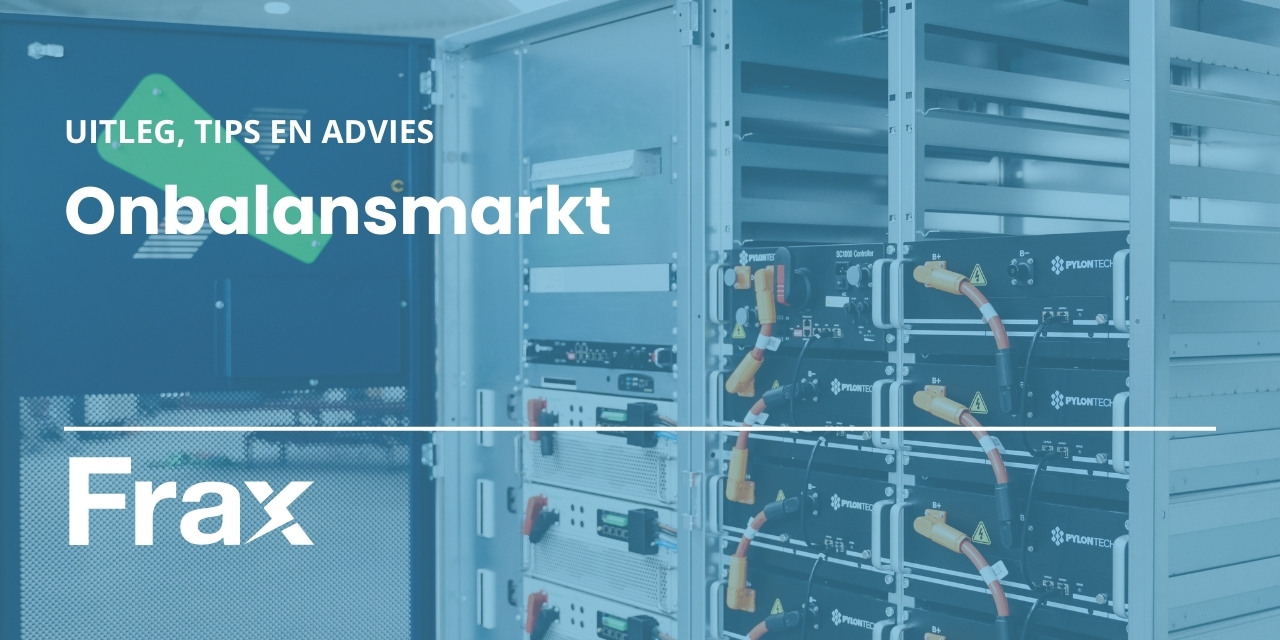
As soon as supply and demand become unbalanced, the grid frequency of 50 Hz deviates from its target and rapid adjustments must be made. These adjustments are made via the imbalance market, a dynamic market where flexibility and rapid responses make all the difference.
What is the imbalance market?
The imbalance market is the mechanism by which the grid operator balances the electricity grid in real time by compensating or charging market parties for providing flexibility. In the Netherlands, TenneT manages this process: when imbalances arise, for example due to fluctuating energy consumption, unexpected outages, or varying renewable energy, control power is used to restore grid stability.
Market parties that can respond quickly, for example by adjusting production up or down, temporarily reducing their electricity consumption, or deploying flexible capacity, help to keep the electricity grid stable and limit frequency differences. The imbalance price is then determined based on the difference between what was predicted in advance and what actually happened, so that your compensation or costs immediately reflect the current situation on the grid.
Who is the imbalance market of interest to?
The imbalance market is particularly interesting for parties that can quickly adapt and respond to changes and that have measurable flexibility. These include energy companies, power generators, large industrial consumers with a high-volume connection, storage companies, and energy traders that can scale their capacity supply when the grid requires it.
Aggregators also play an important role. These are parties that collect and combine the flexibility of multiple smaller energy sources, such as households and smaller businesses, into one larger entity that is large enough to participate in the imbalance market.
Direct participation is usually not an option for private individuals, but you can become indirectly involved by making your flexibility available through parties that organize this. In all cases, the technological requirements are critical: reliable measurement, rapid control with an energy management system, and continuously available capacity determine whether participation is feasible and profitable.
How does trading on the imbalance market work?
Trading on the imbalance market revolves around being able to respond quickly to changes in supply and demand on the electricity grid. To do this effectively, you need not only flexibility, but also insight into market rules, reliable measurement data, and a smart way to access the market. Below you can see a step-by-step overview of how this process usually works.
Understand your role and the rules of the game
Taking action starts with understanding how imbalances arise and how financial settlement works. In short: if you supply or consume more or less electricity than planned in advance, a difference arises that is settled at an imbalance price. That is why it is important to know who is responsible for the energy balance and which party represents the connection to the market. In practice, participation usually involves parties that have access to the relevant markets and that meet requirements for measurement data, communication, and availability.
Make flexibility transparent
You map out specifically what flexible capacity you can deploy and how quickly you can do so. This could involve temporarily reducing power consumption, temporarily increasing power consumption, adjusting production, or absorbing capacity with storage. In doing so, you not only look at what is technically possible, but also at how long you can sustain this and within what limits you can switch safely. This requires real-time monitoring, because the imbalance market depends on current supply and demand and can change quickly.
Choose a route to the market
Depending on your scale and capabilities, you can participate via an energy supplier, a balance responsible party, an aggregator, or an alternative to aggregates . An aggregator is a party that bundles the flexibility of multiple smaller sources into one larger whole, so that the volume becomes large and stable enough to participate at market level. For smaller volumes, cooperation with an aggregator is often the obvious choice, as they largely organize the technical control, coordination, and market access.
Align contract types and measurement
You determine how delivery, compensation, and risks are distributed, and ensure that measurements are reliable and timely. Good measurement data is essential, because it determines what has actually been delivered or adjusted. In some situations, a dynamic energy contract also plays a role, because price incentives and consumption control then move more strongly in line with market developments. This can make it financially more attractive to manage your consumption or storage more intelligently, depending on the moment.
Deliver and evaluate
When there is a grid imbalance, flexibility is used to restore balance to the grid. This often happens automatically, based on signals and settings that have been agreed in advance. This is followed by settlement based on the imbalance price: you can then see what your action has yielded or cost. Because price fluctuations can be significant, evaluation is important, both technically and financially, in order to continue to optimize performance, timing, and risks.
Prices on the imbalance market
Imbalance prices fluctuate in line with the degree of imbalance and the scarcity of flexibility at that moment, which means they can be volatile and sometimes extreme. The imbalance price arises because the grid operator settles the use of balancing power, and that settlement can vary considerably per quarter hour or similar time block.
This makes it important to stay up to date, not only with current prices, but also with the underlying causes such as weather-dependent dynamics, disruptions, peaks in electricity demand, and changes in power supply. Those who make decisions based on outdated information are more likely to encounter unexpected costs or missed opportunities, especially in high-risk, high-return situations.
The link between home batteries and the imbalance market
Home batteries are linked to the imbalance market because they can offer flexibility when supply and demand do not match up neatly, especially in combination with solar panels. Solar energy is more complex to predict than traditional production, which means that deviations occur more often and energy matching becomes more challenging.
A home battery can compensate for fluctuations by charging when there is a surplus and discharging when there is a shortage, making you less sensitive to rapid changes in energy prices and grid conditions.
In practice, the effect is greatest when control and real-time monitoring are well organized, because the value of flexibility arises precisely at times when the market is most dynamic. For example, storage can contribute to a more stable energy consumption profile and to the availability of fast-responding capacity, although market participation for households usually takes place indirectly through organized forms of control.
Future of the imbalance market
The imbalance market is likely to become more important in the coming years, as the share of renewable energy grows and the grid is therefore more frequently confronted with fluctuating production and variable demand. This increases the need for flexibility and rapid responses, making automation and smart control increasingly important.
The role of aggregators is also expected to grow, as they can bundle the flexibility of many small sources into a usable whole. At the same time, technological requirements, measurement quality, and risk management remain important, as yields and costs can vary greatly in the event of deviations. The better flexibility can respond to imbalances, the more stable and efficient the energy system will become.
This post was last updated on:


