
.jpg)
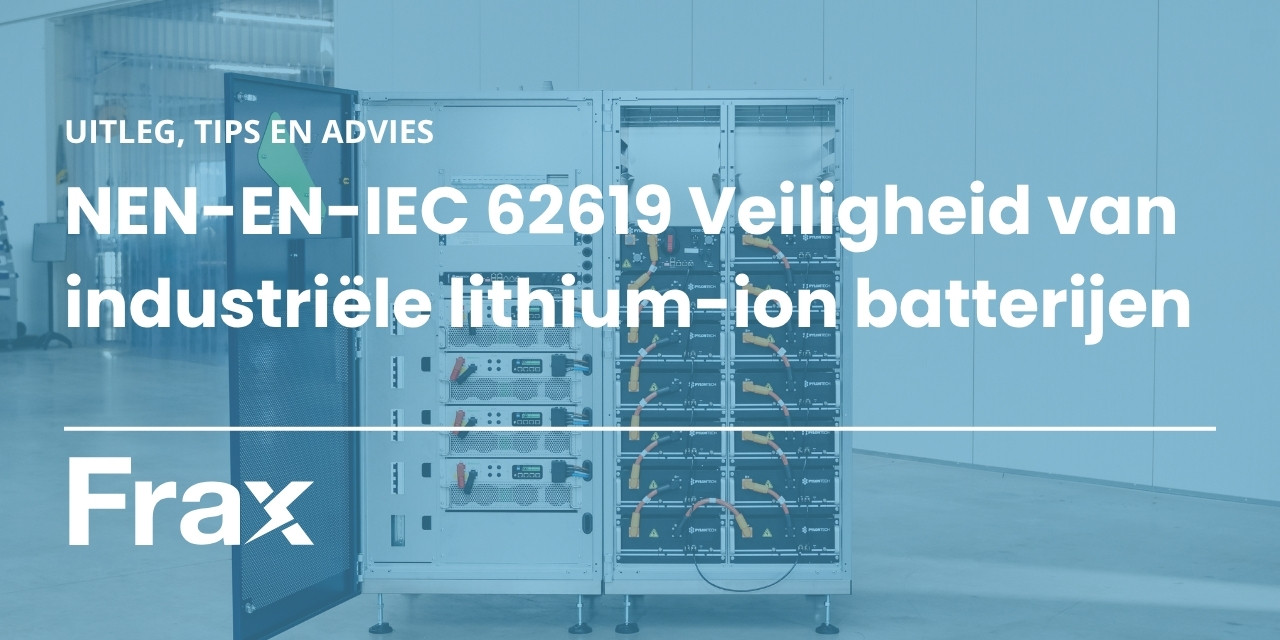
NEN-EN-IEC 62619 What does this safety standard mean for lithium-ion batteries?
The NEN-EN-IEC 62619 standard describes the safety requirements for rechargeable lithium-ion cells and battery systems used in industrial installations. This international standard ensures that batteries can operate safely under a variety of operating conditions, such as high power, long-term loading and varying temperature conditions.
The standard addresses design as well as manufacturing and testing methods to prevent risks such as thermal runaway, short circuit or overcharging.
For manufacturers, installers and end users, compliance with this standard is an important guarantee. A battery that complies with NEN-EN-IEC 62619 has been extensively tested for mechanical, electrical and thermal safety, meaning that it can withstand the tough demands of industrial applications. This ensures reliable operation in energy storage systems, microgrids and industrial energy facilities, among others.
Why the NEN-EN-IEC 62619 is important for battery safety
The NEN-EN-IEC 62619 standard was developed to ensure the safety of industrial lithium-ion batteries. Due to their high energy density and power, the risk of damage or failure is greater than smaller portable applications.
The standard therefore provides a solid framework for manufacturers, integrators and end users to demonstrate and maintain the safety of their installations.
- Protection against overheating, overcharging and internal short circuit.
- Mechanical strength and vibration tests to ensure robustness.
- Thermal and electrical testing for safe performance under harsh conditions.
- Safety requirements for Battery Management Systems (BMS) and electrical protection components.
- International certification that provides confidence within the industrial sector.
Safety requirements according to NEN-EN-IEC 62619: from cell to complete system
The standard looks not only at the individual cell, but at the entire battery configuration. Every part of the system, from the internal chemistry to the electronic protection, must meet the specified safety requirements.
This involves tests that simulate real-world scenarios, such as extreme temperatures, physical shocks or short circuits, to ensure that the system continues to operate safely.
Through this thorough approach, NEN-EN-IEC 62619 helps strengthen the reliability of complete energy storage systems. For industrial applications, where safety and continuity are essential, this standard is an indispensable pillar within design, production and operation of modern battery systems.
The role of NEN-EN-IEC 62619 within energy storage systems (BESS).
In Battery Energy Storage Systems (BESS), lithium-ion batteries play a central role in balancing energy production and consumption. Because these systems often operate on a large scale and handle significant power, compliance with NEN-EN-IEC 62619 is crucial.
The standard ensures that each battery module meets the highest safety standards, both at the cell level and in the complete system design.
Compliance with this standard is not only a technical requirement, but also a prerequisite for insurance, certification and connection to the electrical grid. For integrators and installers at BESS, this means that they can rely on safe and stable operation of their installations, with minimal risks of thermal incidents or electrical faults.
How Frax meets the highest safety standards for lithium-ion batteries
Frax integrates the NEN-EN-IEC 62619 standard into every stage of design and production of its industrial battery storage systems. All plug-and-play solutions are built according to the strictest international safety guidelines and are extensively tested for reliability and durability.
By using certified components and an advanced battery storage system, Frax guarantees maximum safety for both installer and end user.
Frax's EMS continuously monitors the status of each battery module, checking temperature, voltage and charge levels, and intervening automatically in case of deviations. For you as installer, this means worry-free installation and long-term reliable operation. With Frax you choose for innovation, security and full compliance with international safety standards such as NEN-EN-IEC 62619.
This post was last updated on:

